


Ukrainian Navy Confirms High-Tech Swedish Missile Used in Oil Rig Strike
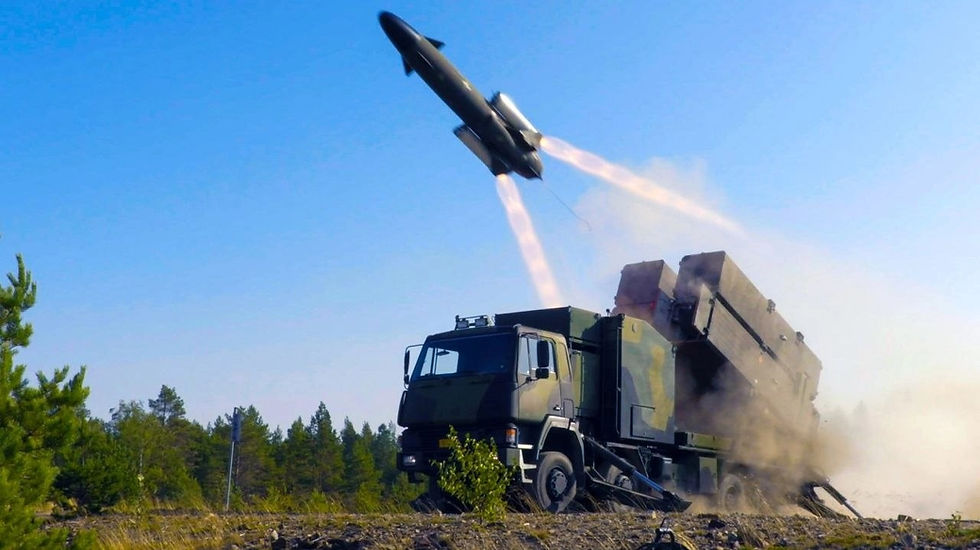
April 8 ------ The Ukrainian Naval Forces employed a salvo of advanced Swedish high-tech anti-ship missiles to blow up a Black Sea drilling rig held by Russian forces recently, an official Kyiv military statement said.
Video made public by the Ukraine Naval Forces late on Monday evening showed images of at least two missile-shaped objects striking and detonating against the Sivash platform, a self-elevating jack-up some 60–80 km northwest of the Crimean coast. Russian forces had been using the abandoned drilling platform for airspace monitoring, electronic warfare, and as an air defense platform.
The three-minute edited Ukrainian video showed the nighttime launch of two missiles and later powerful explosions on the rig’s main deck. Other images recorded by air and sea drones showed Ukrainian kamikaze robot boats and FPV drones attacking the site in a furious night naval action.
According to the Ukrainian navy, the strikes were executed employing RBS-15 (Robotsystem 15) Gungir missiles, a Swedish-designed, long-range fire-and-forget anti-ship weapon developed by Saab Bofors Dynamics. Both Russian and Ukrainian military media on Tuesday confirmed the Swedish missile had been used in the battle.
The 4.35 m-long missile, per SAAB statements, may be launched from a ship, air, or ground, weighs about 650 kg, cruises at slightly less than Mach 1.0 (the speed of sound), and travels to its target using an inertial navigation system (INS), GPS and terminal active radar homing. The fire-and-forget functionality means these systems operate entirely within the missile and require no input after being launched at the target.
According to corporate information, the RBS-15 is optimized for cluttered coastal or open-sea environments and is equipped with advanced avionics, incorporating built-in ECCM [electronic counter-countermeasures] technology. The technology in its design, and the lack of need for external updates after launch make the weapon innately resistant to jamming, spoofing, etc.
Initially fielded in the 1980s, the RBS-15 has been continuously upgraded, and its latest Mark IV modification is considered an advanced, precision-guided naval weapon. The Ukrainian navy statement said that each RBS-15 delivered a conventional 200 kg high-explosive warhead to the target, but offered no details on which iteration of the missile it had used in the attacks, nor did it say how the Ukrainian military acquired the weapons.
Ukraine produces a domestically developed anti-ship cruise missile called the Long Neptune that has proved successful in combat. About 20 percent heavier than the RBS-15, the Ukrainian Neptune has a simpler design and is less resistant to jamming, but flies further and carries a bigger warhead.
The best-known Neptune strike of the Russo-Ukraine War took place in April 2022 when the flagship of Russia’s Black Sea fleet, the cruiser Moskva, was hit and sunk by a pair of Ukrainian anti-ship missiles and sunk. Since then, the Ukrainian military has used its Neptune missiles to hit other Russian warships, air defense radars, ferries, energy infrastructure, drone launch sites, and military component factories in about 50 confirmed attacks.
Russian missile and drone strikes against the two main component production sites of the Neptune missile, the Luch Design Bureau in Kyiv and the Motor Sich engine and aerospace factory in Zaporizhzhia, have damaged workshops, killed and wounded factory staff, and reduced Ukrainian capacity to produce Neptune missiles in larger quantities.
Source: kyivpost.com


Comments