


Philippines, India forge strategic partnership, ink 13 deals
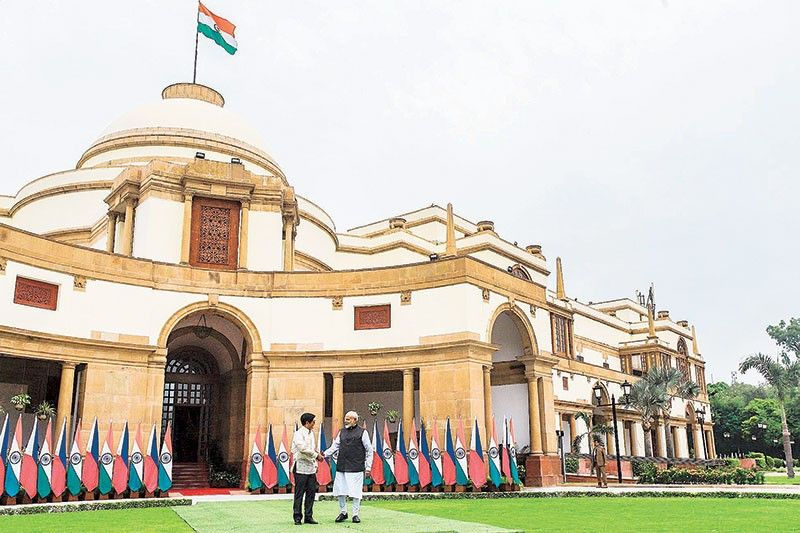
MANILA, Philippines, August 6 ------ The Philippines and India formally established a strategic partnership paving the way for stronger bilateral ties and broader cooperation in various sectors.
The declaration on the establishment of a strategic partnership was among 13 documents exchanged during the second day of President Marcos’ five-day state visit to India. Marcos said the partnership would intensify cooperation in areas that Manila had not fully explored with New Delhi before, such as defense, trade and investment, health and tourism. “I come at a crucial juncture in our bilateral partnership. Today our relationship entered a new epoch as Prime Minister (Narendra) Modi and I formally launched the strategic partnership between the Philippines and India. For the Philippines, this is a momentous decision, for we take a very considered path to such elevated partnerships,” the President said after his bilateral meeting with Modi.
The meeting makes India the Philippines’ fifth strategic partner after Japan, Vietnam, Australia and South Korea. “This new apex attests as much to the remarkably rapid growth, broadening and deepening of our 75-year-old bilateral relationship, the possibilities represented by the strong upward trajectory of our two economies as it does to the growing alignment of our interests and views on the challenges and imperatives of our time,” Marcos said.
The strategic partnership declaration was accompanied by a plan of action covering 2025 to 2029. Other agreements signed include terms of reference for staff talks between the Philippine and Indian air forces, armies and navies; treaties on mutual legal assistance in criminal matters and on the transfer of sentenced persons; programs of cooperation on science and technology and tourism; a memorandum of understanding on digital technologies; a statement of intent on peaceful uses of outer space; an agreement for enhanced maritime cooperation between coast guards and a cultural exchange program.
Aside from enhancing bilateral cooperation, Marcos and Modi discussed the importance of the rule of law and a free Indo-Pacific. “Prime Minister Modi and I have committed to bring our collaboration to bear on shared concerns: a free, open and inclusive Indo-Pacific region, security and rule of law in the maritime commons, supply chain resilience, food security, countering terrorism and other traditional and non-traditional threats,” Marcos said. “Relative to the maritime sphere, I thank Prime Minister Modi once again for India’s support for the peaceful settlement of disputes and adherence to international law, especially the UNCLOS (United Nations Convention on the Law of the Sea) and the 2016 award in the South China Sea arbitration,” he added.
The 2016 award invalidated China’s sweeping claims in the South China Sea and affirmed the Philippines’ sovereign rights over its 200-nautical-mile exclusive economic zone. China, however, refuses to recognize the ruling. Marcos, who will chair the Association of Southeast Asian Nations next year, thanked Modi for supporting the bloc’s unity and centrality as well as the Philippines’ upcoming chairmanship.
The two leaders agreed to boost collaboration in defense and security, including mechanisms for service-to-service talks, information sharing and training exchanges. They also committed to foster naval and coast guard interoperability through port calls, joint activities and capacity-building in the maritime domain. “We expressed satisfaction over the rapid pace of the Philippines’ ongoing defense modernization and expanding capabilities and footprints of India’s indigenous defense industry as a partner in this undertaking, exemplified by our BrahMos project,” Marcos said.
Marcos and Modi also instructed their economic teams to keep trade on an upward trajectory and expand the basket of goods exchanged. “We have decided to expedite the work that we are doing to forge a bilateral preferential trade agreement. We look at leveraging mutual opportunities to boost two-way investment,” Marcos said.
Source: philstar.com


Comments