


Maritime leaders debate the industry’s future at Posidonia
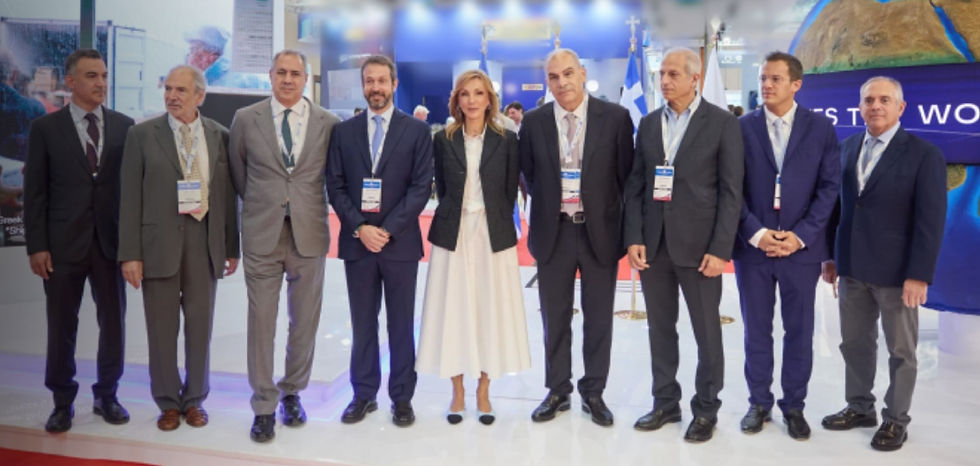
June 6 ------ At the Posidonia 2026, discussions at the Athens Metropolitan Expo extended well beyond geopolitics, cargo volumes, insurance costs and charter rates.
Instead, some of the most influential voices in global maritime governance, including the Secretary-General of the International Maritime Organization (IMO), the President of the Union of Greek Shipowners, and shipping ministers from several of the world’s leading flag states, focused attention on two challenges widely seen as defining the future of the industry – safeguarding the welfare, safety and dignity of seafarers, and accelerating the transition toward a lower-carbon shipping sector.
The debate underscored a growing consensus that the next decade of maritime development will be shaped not only by commercial and regulatory pressures, but also by the industry’s ability to protect its workforce and meet increasingly ambitious decarbonization targets.
Seafarers at the center of the global agenda
When asked to identify the single most pressing item on the IMO’s agenda, Secretary-General Arsenio Dominguez said: “Seafarer wellbeing and seafarer safety is our top priority. The industry depends on the people, the men and women, who are on ships day in day out, responsible for keeping global trade running.” "In zones of conflict, it is the seafarers who are on the front line, dealing with uncertainty, psychological stress and concern for their own families. The most pressing agenda right now is to seek de-escalation and resolution of conflict. I will continue to engage with all States and stakeholders to speak up for seafarers," Dominguez noted.
The statement carried particular weight given the current geopolitical climate – with maritime trade routes under pressure from regional conflicts and chokepoint tensions that have placed merchant vessels, and the seafarers aboard them, in harm’s way with increasing frequency. "I call on the industry to stand with IMO in defending the principle of freedom of navigation, including the rejection of tolls and discriminatory transit measures. I hope that Posidonia will see strong commitments to the energy transition, with increased focus on energy efficiency technologies, alternative fuels and looking to the future with orders for dual fuel ships," Arsenio Dominguez further commented while highlighting the need to keep investing in workforce, championing diversity and inclusion while finding more ways to attract the next generation of seafarers.
No voice carries greater weight at Posidonia than that of the Greek ship owning community and this year, Union of Greek Shipowners President Melina Travlos used her address to offer the perspective of the most powerful shipping nation in the world. "Seafarers should never have to face conditions of increased risk, let alone risks to their very lives. We hope that peace and respect for international law will prevail, so that the seas remain open, safe, and free for the benefit of all peoples," Travlos remarked.
Furthermore, green transition Travlos argued, cannot be treated as a problem that the shipping industry can solve alone, or on a timeline determined by regulatory convenience rather than technological and infrastructural readiness. "Shipping’s decarbonization is utterly dependent upon external factors. The availability of safe fuels, fit-for-purpose technologies and adequate infrastructure depend entirely on other sectors. The green transition requires technological feasibility, economic viability, global coordination, and a level playing field. Otherwise, higher costs will be imposed on the entire supply chain without delivering the corresponding environmental benefits," said Melina Travlos.
Flag States seek clarity amid regulatory uncertainty
Among flag states, Malta has emerged as a vocal advocate for a more proactive approach to the current regulatory uncertainty.
Its position rests on three interlocking convictions:
• that global solutions must ultimately prevail over regional ones;
• that technology neutrality through a goal-based approach is non-negotiable;
• and that, in the interim, flag state administrations have a responsibility to fill the regulatory vacuum with authoritative, commercially useful guidance.
"We are actively moving past administrative sluggishness; if a vessel can thoroughly prove its safety through Alternative Design and Arrangements, our technical department will facilitate its deployment now, rather than allowing it to be delayed by bureaucratic backlogs," said Dr. Ivan Tabone, Registrar General of Shipping and Seamen, Malta Ship Registry.
The Registry’s approach to the IMO framework’s delayed finalization is equally direct. As explained, Malta is not waiting for diplomatic resolution before preparing its fleet for the operational reality of the metrics that will eventually govern global shipping emissions.
Dr. Ivan Tabone continued: “The IMO Net-Zero Framework may be experiencing diplomatic and political delays, but the work on technical guidelines must not pause, and Malta is actively preparing its fleet for the operational reality of Greenhouse Gas Fuel Intensity metrics today. Malta continues to advocate firmly for a unified, global level playing field that rewards real-world carbon reduction, rather than forcing shipowners to navigate fragmented, check-the-box regional compliance frameworks.”
In addition, Cyprus Shipping Minister Marina Hadjimanolis arrived at Posidonia 2026 with a message that spoke as much to the process of good governance as to the substance of maritime policy. "Shipping is facing multiple pressures simultaneously, from geopolitical instability and trade disruptions to the challenges of decarbonization, digitalization and the evolving regulatory landscape. Open and constructive dialogue between policymakers and industry stakeholders is therefore more important than ever," she noted.
Hadjimanolis also highlighted the human capital dimension of maritime transformation, noting that the digitalization of shipping places a premium on continuous investment in workforce skills – a theme that echoed the IMO Secretary-General’s own emphasis on the people at the heart of the industry.
Maritime hubs prepare for the future
From the other side of the world – but deeply embedded in the same global conversation – Singapore’s Senior Minister of State for Law and Transport, Murali Pillai, brought the perspective of Asia’s pre-eminent maritime hub to Posidonia 2026. "Amidst a more complex and rapidly evolving operating environment, Singapore remains committed to being a trusted node in global trade. We are charting the course ahead and investing in our port’s digital and decarbonization capabilities to support a more resilient, efficient and sustainable maritime future," Murali Pillai commented.
Gibraltar also highlighted its role as a major Mediterranean port and bunkering hub serving international shipping. Perched at the gateway between the Atlantic Ocean and the Mediterranean Sea, the British Overseas Territory sits astride one of the world’s busiest shipping corridors, through which an estimated 60,000 vessels pass each year. Geography has long been central to Gibraltar’s maritime identity, but at Posidonia 2026, officials were keen to emphasize that the jurisdiction’s ambitions extend far beyond its natural advantages.
Addressing delegates, Minister Gemma Arias-Vasquez, outlined the territory’s approach to two of shipping’s most pressing challenges: seafarer welfare and decarbonization. “Gibraltar’s perspective is rooted in its role as a major Mediterranean port and bunkering hub,” she said. "We support seafarers’ rights through practical welfare support for crews visiting Gibraltar, strong Maritime Labor Convention standards for Gibraltar-flagged vessels, and a port community that recognizes seafarers as essential to global trade," highlighted Gemma Arias-Vasquez.
On the industry’s energy transition, Arias-Vasquez stressed the need for a pragmatic approach. “Gibraltar supports a realistic transition through cleaner bunkering, readiness for alternative fuels and close alignment with IMO objectives, ensuring the maritime sector reduces emissions while remaining safe, competitive and operationally resilient,” she further noted.
An industry at a critical juncture
As the third day of Posidonia 2026 drew to a close, a common theme had emerged across the conference halls, shipping is entering a period of profound transformation.
The regulatory framework that will govern maritime decarbonization is still taking shape, often amid complex negotiations and competing national interests. At the same time, geopolitical instability continues to challenge established norms of free navigation while placing renewed pressure on the safety and wellbeing of seafarers operating in increasingly volatile regions.
Against this backdrop, the decisions being made today by maritime administrations, flag states, ports and shipping centers are likely to define the industry’s trajectory for decades to come.
If there was a unifying message, it was that shipping’s future will be shaped as much by its commitment to people as by its response to environmental imperatives. Those twin priorities, people and planet, have become increasingly central to Posidonia itself.
Source: safety4sea.com


Comments